


Invest in Oil Wells: A Guide in how to invest in Oil and Gas in 2025
The U.S. oil and gas sector continues to present compelling investment opportunities for accredited investors seeking direct exposure to energy assets.
Investing in oil and gas wells through Direct Participation Programs (DPPs) and private placements offers unique advantages, including substantial tax benefits and potential for significant returns.
However, these investments require sophisticated analysis and understanding of inherent risks.
Key Takeaways for Oil and Gas Investment Success
- Tax-advantaged income: Intangible drilling costs can provide 60-80% first-year deductions
- Direct ownership: Working interest provides real stakes in domestic energy production
- Portfolio diversification: Energy assets can hedge against inflation and market volatility
- Accredited investor requirement: Minimum $200,000 annual income or $1 million net worth
- Long-term commitment: Investments typically require 5-10 year holding periods
Understanding How to Invest in Oil and Gas Wells
When you invest in oil wells, you gain direct participation in energy production rather than purchasing shares of publicly traded companies. This direct investment approach allows investors to benefit from the physical production of oil or gas, linking returns directly to commodity extraction and sales.
Types of Oil and Gas Investment Structures
Oil and gas investment opportunities typically structure through limited partnerships (LPs) or limited liability companies (LLCs). In these arrangements, the investor becomes a limited partner contributing capital while a general partner manages day-to-day drilling and production activities.
This pass-through tax structure means income, losses, deductions, and tax credits flow directly to individual investors, avoiding corporate-level taxation.
The oil and gas industry offers several investment vehicles for those looking to invest in oil and gas:
Working Interest Investments: Provide direct ownership in wells with both revenue participation and operational cost responsibility. These investments offer the highest potential returns but carry proportional operational risks.
Royalty Interest Investments: Generate income from oil and gas production without operational responsibilities. Royalty owners receive a percentage of production revenue while operators handle all drilling and maintenance costs.
Direct Participation Programs: Allow investors to pool resources for larger projects while maintaining individual tax benefits. These programs typically focus on development wells in proven fields or exploration ventures in promising territories.

Investment Opportunities in the Oil and Gas Sector
The U.S. Energy Information Administration projects natural gas production will increase to between 42.6 and 44.3 trillion cubic feet in the early 2030s, up from 38.4 Tcf in 2024. This growth is primarily driven by robust Liquefied Natural Gas (LNG) export demand, with LNG exports projected to peak at 9.8 Tcf in 2040, more than doubling 2024 volumes.
Oil and Gas Investment Companies Leading the Market
Top oil and gas investment companies focus on proven operators with strong track records in successful exploration and production. When evaluating oil and gas investment companies, investors should prioritize firms demonstrating transparency in operations, financial health disclosure, and commitment to regulatory compliance.
Regional Investment Opportunities
Oil Wells in Texas: The Permian Basin continues driving U.S. crude oil production growth through 2030, with production potentially reaching 14.0 million barrels per day by 2027-2028. Texas oil wells benefit from established infrastructure, experienced operators, and favorable regulatory environments.
Emerging Opportunities: While traditional oil-producing regions offer stability, emerging fields present higher risk-reward profiles. Investors should carefully evaluate geological data, operator expertise, and infrastructure availability when considering opportunities in less-developed regions.
Benefits Associated with Oil and Gas Investments
Tax Benefits Associated with Oil and Gas Investments
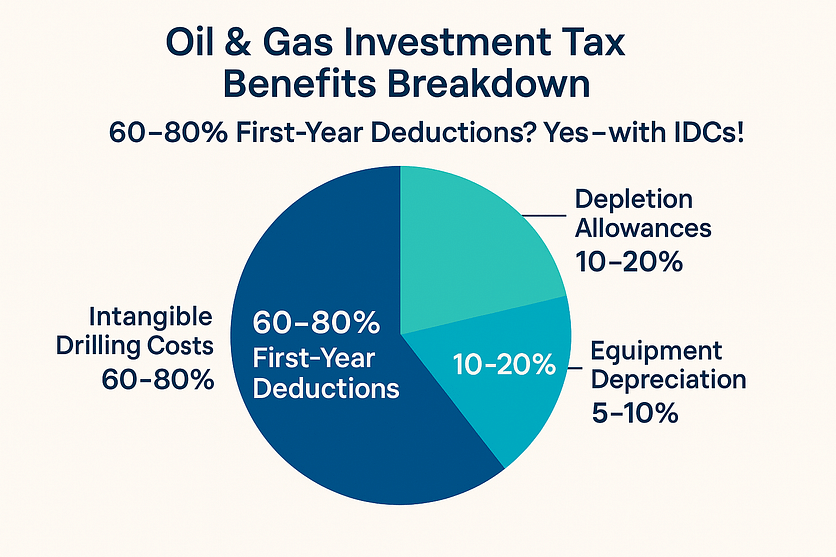
The primary attraction for many investors centers on substantial tax advantages. U.S. tax regulations allow significant deductions through intangible drilling costs (IDCs), which can comprise 60-80% of initial investment and are often fully deductible in the first year.
For example, a qualified attorney earning $285,000 who invests $150,000 in a working interest could potentially deduct the full amount against their income, generating tax savings of approximately $75,750 at a 50.5% combined tax rate.
Additional tax benefits include:
- Tangible drilling cost deductions
- Depletion allowances under IRC §611/613A
- Depreciation on equipment and infrastructure
Some structures may also allow deferred tax liability, depending on the holding period and reinvestment strategy
Income from Oil and Gas Production
Direct investment in oil wells generates income through monthly or quarterly distributions once production begins, typically within 6-12 months of initial investment.
Revenue streams depend on production volumes, commodity prices, and operational efficiency.
Risks Associated with Investing in Oil and Gas
Financial and Market Risks
Oil and gas investments face significant price volatility influenced by global supply-demand dynamics, geopolitical events, and broader economic conditions. Short-term forecasts indicate WTI crude oil prices may fall to $53 per barrel by end-2026, representing a 22% decline from June 2025 prices.
This price sensitivity directly impacts project revenue and investment returns.
In addition, geopolitical instability—such as tensions in oil-rich regions or conflicts affecting global supply routes—can significantly impact commodity prices and investor returns, introducing further volatility to project outcomes.
Operational and Geological Risks
Drilling operations carry inherent risks including:
- Exploration failure: “Dry holes” that produce no commercial quantities
- Reserve uncertainty: Actual production may differ significantly from estimates
- Equipment failures: Mechanical issues, blowouts, or infrastructure problems
- Environmental hazards: Spills, contamination, or regulatory violations
Regulatory and Policy Risks
Changes in government policies, environmental regulations, or tax laws can directly impact profitability. The evolving energy policy landscape creates uncertainty as traditional fossil fuel support intersects with accelerating renewable energy transitions.
These offerings are typically regulated by the Securities and Exchange Commission (SEC) and may also require state-level filings and compliance, depending on the offering structure.
How Oil and Gas Companies Generate Returns
Production and Revenue Models
Oil and gas companies generate returns through efficient extraction and sale of hydrocarbons. Return on Invested Capital (ROIC) serves as a critical metric, influenced by exploration costs, production efficiency, and commodity market prices.
Successful companies leverage advanced technologies including AI, IoT, and digital twins to optimize operations and reduce costs.
Technology Integration Impact
Modern oil and gas operations increasingly rely on sophisticated technologies:
- Artificial Intelligence: Predictive maintenance and drilling optimization
- Internet of Things: Real-time monitoring and automated systems
- Digital Twins: Virtual asset replicas for scenario testing and optimization
- Blockchain: Enhanced supply chain transparency and security
While these technologies improve efficiency, they also increase capital intensity and complexity for new projects, particularly as easily accessible reserves become depleted.
Direct Investment Strategies for Oil and Gas
Evaluating Oil and Gas Investment Opportunities
Comprehensive due diligence requires multi-disciplinary expertise covering:
Financial Analysis: Review historical performance, debt levels, cash flow, and reserve valuations. Assess operator financial stability and ability to fund operations through commodity price cycles.
Geological Review: Evaluate reservoir properties, production data, and subsurface challenges. Understanding porosity, permeability, and trap integrity is vital for forecasting production rates and hydrocarbon output.
Operator Assessment: Research management expertise, industry reputation, and track record of successful exploration and production. Prioritize operators with proven ability to integrate advanced technologies and maintain regulatory compliance.
Investment Minimums and Structures
Most oil and gas investment opportunities require accredited investor status, defined as individuals earning $200,000 annually ($300,000 joint income) or possessing $1 million net worth excluding primary residence.
Investment minimums typically range from $25,000 to $100,000 or more, depending on project scope and structure.
Oil and Gas Stocks vs. Direct Investment
Comparing Investment Approaches
Oil and gas stocks provide liquid exposure to energy markets through publicly traded companies, while direct investment offers working interest ownership in specific projects.
Stocks offer easier entry and exit but lack direct tax benefits and commodity exposure available through working interest investments.
Portfolio Integration Strategies
Financial advisors before investing often recommend limiting energy exposure to 5-10% of total investment portfolios. Direct oil and gas investments should complement, not replace, diversified equity and fixed-income holdings.
The illiquid nature of working interest investments requires investors to maintain adequate liquid reserves for other financial needs.
Market Outlook and Future Opportunities
Production Forecasts and Demand Drivers
U.S. crude oil production is expected to grow through 2030, reaching approximately 14.0 million barrels per day in optimistic scenarios. Natural gas production will benefit from continued LNG export growth, with international demand supporting U.S. production through 2050.
Energy Transition Considerations
While renewable energy sources experience significant growth, continued upstream investment in oil and gas remains necessary to offset production declines and meet transitional energy demand.
Investors should consider both short-term opportunities and long-term transition dynamics when evaluating oil and gas investments.
Conclusion: Making Informed Oil and Gas Investment Decisions
Investing in oil and gas wells offers sophisticated investors unique opportunities for tax-advantaged returns and portfolio diversification. Success requires thorough due diligence, appropriate risk management, and alignment with long-term investment objectives.
While these investments carry substantial risks including price volatility, operational challenges, and regulatory uncertainty, they can provide valuable exposure to domestic energy production for qualified investors.
The key to successful oil and gas investing lies in selecting experienced operators, understanding tax implications, and maintaining realistic expectations about risk and return profiles.
As the energy landscape continues evolving, direct participation in oil and gas production offers a tangible alternative to traditional energy sector investments while supporting domestic energy security during the ongoing energy transition.