





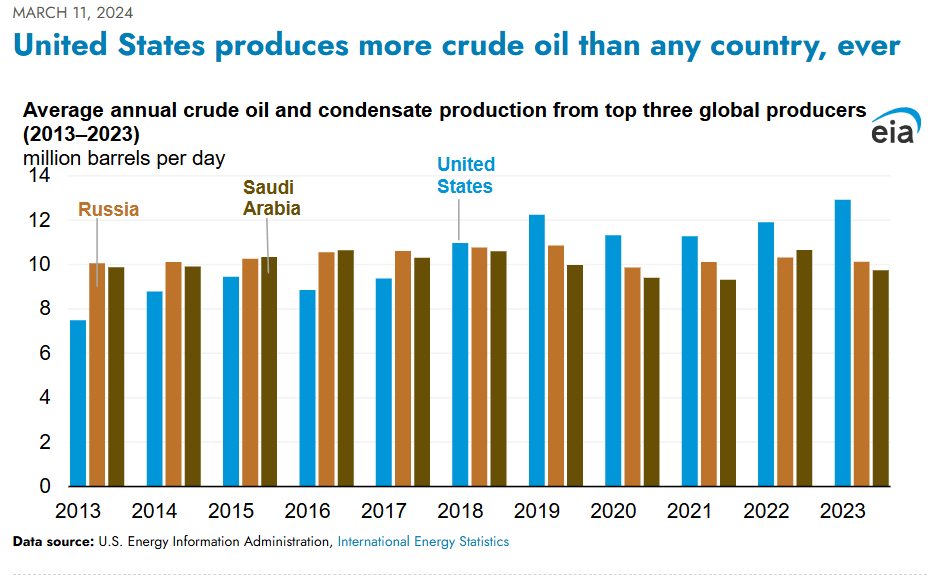
In a remarkable achievement, the United States has firmly established itself as the world’s top producer of crude oil, setting records that no other nation has come close to matching.
Over the past six years, the US has consistently outpaced all other oil-producing countries. In 2023, US crude oil production averaged an astonishing 12.9 million barrels per day (b/d), surpassing its previous record of 12.3 million b/d set in 2019. December 2023 alone saw an unprecedented monthly peak of more than 13.3 million b/d, highlighting the nation’s unmatched capacity and sustained growth.
According to international energy statistics, this level of output marks the sixth consecutive year in which no other nation has produced as much crude oil, solidifying the US’s dominance in the global energy market.
Unmatched Production Capacity
No other country has managed to achieve a production capacity of 13.0 million b/d, making the US’s record exceptionally difficult to surpass in the foreseeable future.
Saudi Arabia, a traditional oil powerhouse, recently abandoned its plans to expand production capacity to this level, underscoring the extraordinary nature of US output. Industry experts assert that “the crude oil production record in the United States in 2023 is unlikely to be broken by any other country in the near term because no other country has reached production capacity of 13.0 million b/d.” This fact reinforces the nation’s position as an unparalleled leader in the global oil industry.
Global Oil Market Leadership
The United States, Russia, and Saudi Arabia collectively accounted for 40% of global crude oil production in 2023, with a combined output of 32.8 million b/d. These three nations have held the top spots in global production rankings since 1971, although leadership among them has shifted over time due to changing geopolitical and economic conditions.
Despite this shared dominance, the United States continues to stand apart, producing nearly as much oil as the combined total of the next three largest producers—Canada, Iraq, and China—which collectively generated 13.1 million b/d in 2023. This stark contrast highlights the significant production gap between the top-tier producers and their closest competitors.
Historical Trends and Technological Advancements
US crude oil production reached a peak of 9.6 million b/d in 1970 before entering a prolonged period of decline, eventually hitting a low of 5.0 million b/d in 2008. However, a technological revolution in extraction methods ignited a dramatic resurgence beginning in 2009.
Producers began implementing hydraulic fracturing (fracking) and horizontal drilling techniques, unlocking vast reserves of previously inaccessible oil and transforming the energy landscape. Since then, US production has grown steadily, propelling the nation to a position of unprecedented leadership in global crude oil output.
The Permian Basin, located across western Texas and eastern New Mexico, has played a pivotal role in driving this growth. This resource-rich region has become a cornerstone of US crude oil and natural gas production, providing a stable foundation for the nation’s ongoing dominance.
Advances in drilling technology and resource management have maximised production efficiency in the Permian Basin, contributing to the US’s long-term sustainability in the energy sector.
The Impact of External Events
Although US production growth has been largely consistent, it faced temporary setbacks during the COVID-19 pandemic in 2020 and 2021. Reduced global demand and plummeting prices forced producers to cut back, leading to a brief decline in output.
However, the industry quickly rebounded as economic conditions stabilised, reaffirming the resilience of the US energy sector. This swift recovery demonstrated the adaptability of American producers in responding to market fluctuations and external challenges.
Russia and Saudi Arabia’s Production Trends
Russia’s crude oil production peaked at 10.8 million b/d in 2019, trailing the US by 1.4 million b/d. In response to geopolitical tensions and the ongoing conflict in Ukraine, Russia implemented production cuts in coordination with other OPEC+ countries in late 2022 and early 2023.
Although the announced cuts were more extensive than what was ultimately realised, Russia’s output still declined by 200,000 b/d in 2023, reflecting the broader impact of international sanctions and market pressures.
Meanwhile, Saudi Arabia’s production peaked in 2022 at 10.6 million b/d, 1.3 million b/d less than US levels. Production fell by 900,000 b/d in 2023 due to both OPEC+ agreements and additional voluntary cuts.
Saudi Aramco, the kingdom’s state-owned oil giant, maintains a production capacity of 12.0 million b/d, with approximately 300,000 b/d of additional capacity derived from its share of the Neutral Zone, a resource area shared with Kuwait. Despite these capabilities, Saudi Arabia remains unable to match the output levels achieved by the United States.
Themes and Implications
Energy Independence and Dominance: The US’s position as the world’s leading oil producer signifies a profound shift in global energy dynamics. By capitalising on technological innovation and resource management, the nation has challenged long-standing patterns of energy dependence and asserted a position of dominance in the oil market. This newfound independence provides strategic advantages, enhancing both economic stability and national security.
Geopolitical Influence: The scale of US production has significant implications for international relations. As the world’s top producer, the US has strengthened its influence on global energy policies and market stability. This leadership position enables the nation to play a decisive role in shaping the future of global energy production and consumption, potentially redefining power dynamics among major oil-producing countries.
Technological Innovation: The success of US crude oil production is closely tied to advancements in extraction technology. Hydraulic fracturing and horizontal drilling have revolutionised the industry, enabling producers to access previously untapped reserves and optimise output. These technological innovations have reshaped the economics of oil production, lowering costs and improving efficiency across the sector.
Economic and Market Effects: Increased production has yielded substantial benefits for the US economy, enhancing energy security and supporting industries reliant on stable oil supplies. The vast scale of US output exerts downward pressure on global oil prices, influencing market dynamics and affecting producers and consumers worldwide. As a result, the US has become a key stabilising force in the international energy market.
Conclusion
The United States’ record-breaking crude oil production in 2023 marks a pivotal moment in the global energy landscape. Through technological ingenuity, strategic development, and effective resource management, the nation has solidified its status as the world’s top oil producer. As geopolitical and market dynamics continue to evolve, the US’s role in shaping the future of energy remains both pivotal and unparalleled. With a strong foundation of innovation and adaptability, the United States is poised to maintain its leadership for years to come.




Add Comment